A bit late with this, but my commentary on using Angie Thomas’s novel The Hate U Give to educate future physicians on anti-racism appeared in Academic Medicine 97 (7).

Fall 2022 Featured Artist: Laura Karetzky
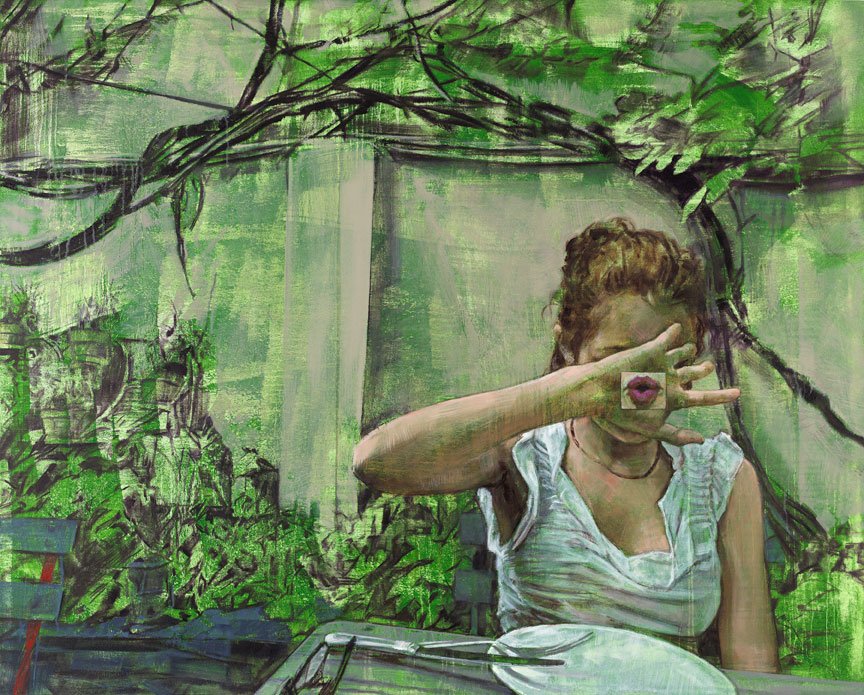
Embedded Mid Drift 2019
oil on wood, 48 x 60 inches
Laura Karetzky
I find myself drawn to Karetzky’s work for many reasons—the monochromatic palette, the peephole nature of perspective portrayed, the intimate (but not) subject matter. All of these appeal greatly, but if I had to pick one thing, it would be the texture. While I haven’t seen any of her paintings in person, the digital images undoubtedly affirm scratches, streaks, drips, and chisels—a quality that, for whatever reason, makes me feel drawn into another reality. And perhaps that is the point, to visit someone else’s reality. As Emily Capone notes in her review of Karetzky’s 2021 Concurrence exhibition:
“Karetzky’s choice and application of her medium is purposeful. Each layer has a reason. The primed wood and textured backgrounds insinuate a history of use, much like finger streaks on a window or a tablet screen, while the layer itself is the first “window.” The actual windows evoke the physical engagement of the viewer, whether through a genuine representation in real time or through a time capsule. This hybridization is something Karetzky touches on with paintings such as Teal Text and Remote Screen. The play on words and the literal juxtaposition of the teal window on a digital screen is a stark contrast to the reflections through a mirror in Green Key or Points and Palms.”

Points And Palms 2022
oil on panel, 60 x 48 in
Laura Karetzky received her BFA from Carnegie-Mellon University, an MFA from The New York Academy of Art, and engaged in additional training at the School of Visual Arts, The New York Studio School, the Rhode Island School of Design, as well as extensive study in Florence, Italy. She is the recipient of several awards and fellowships including 2021 New York Studio School Artcritial Prize; 2020 New York Studio School Mercedes Matter Award; 2017 ESKFF Mana Contemporary Residency; 2014 Milton and Sally Michel Avery endowed Fellowship at Yaddo; 2011 Yaddo Fellowship; and 2009 New York Academy of Art Eric Fischl Award of Distinction. Laura Karetzky lives and works in Brooklyn, NY.
from the Luis De Jesus gallery:
”For many years, Laura Karetzky has been interested in the effect that communicating, specifically through technological means, has on perception. Since the pandemic, we have relied substantially on live-media platforms to perform our daily functions, and now we appear to be stuck somewhere between the real and virtual – a hybridization of witnessing the world, both in and around us.
The phenomenon of being inside our bodies and outside, on other screens, in other windows, and in other places, has changed our understanding of space forever as the boundaries of each are merging. This has led Karetzky to question the images she sees in every aspect of her visual field. With this body of work, she addresses the story inside another story, a window in a window so to speak, superimposed or inherently found; life reinstated inside itself.”

Stripped 2021
oil on wood, 30″ x 24″

Toast 2019
oil on panel, 48” x 60”
Spring-Summer 2022 Featured Artist: Tiffany Alfonseca

Alfonseca Rondon 2021
Acrylic, color pencil, glitter on canvas, 72 x 60 inches
Tiffany Alfonseca (b. 1994) is a Bronx- based Dominican-American mixed media artist who creates vibrant and colorful artworks that celebrates Black and Afro-Latinx diasporic culture. Alfonseca continuously taps into her Afro-Dominican roots and leverages it as a conceptual cantilever that provides a dynamic framework for her artistic practice. Moreover, her work aims to visually articulate that the Black and Afro-Latinx diaspora does not exist within a monolith, but that these communities are a cultural cornucopia that is vast, varied, and complex. Alfonseca’s artwork is an intricate combination of beauty, diversity, and multilingualism that exemplifies the strength of the Black and Afro-Latinx diaspora. (from tiffanyalfonseca.com)
As a mixed media artist, Alfonseca combines acrylic paint, charcoal, and glitter for her creations, breathing life into the two-dimensional art form through texture and depth. She draws inspiration from her own background and themes present in her culture, often depicting her loved ones and objects reminiscent of her childhood. By mixing patterns, colors, and mediums, Tiffany manages to brighten those quotidian tasks like bathing or folding laundry. (from LATINA)

Alfonseca presented her first solo exhibition, De Las Manos Que Nos Crearon, in Fall 2021 at The Mistake Room.
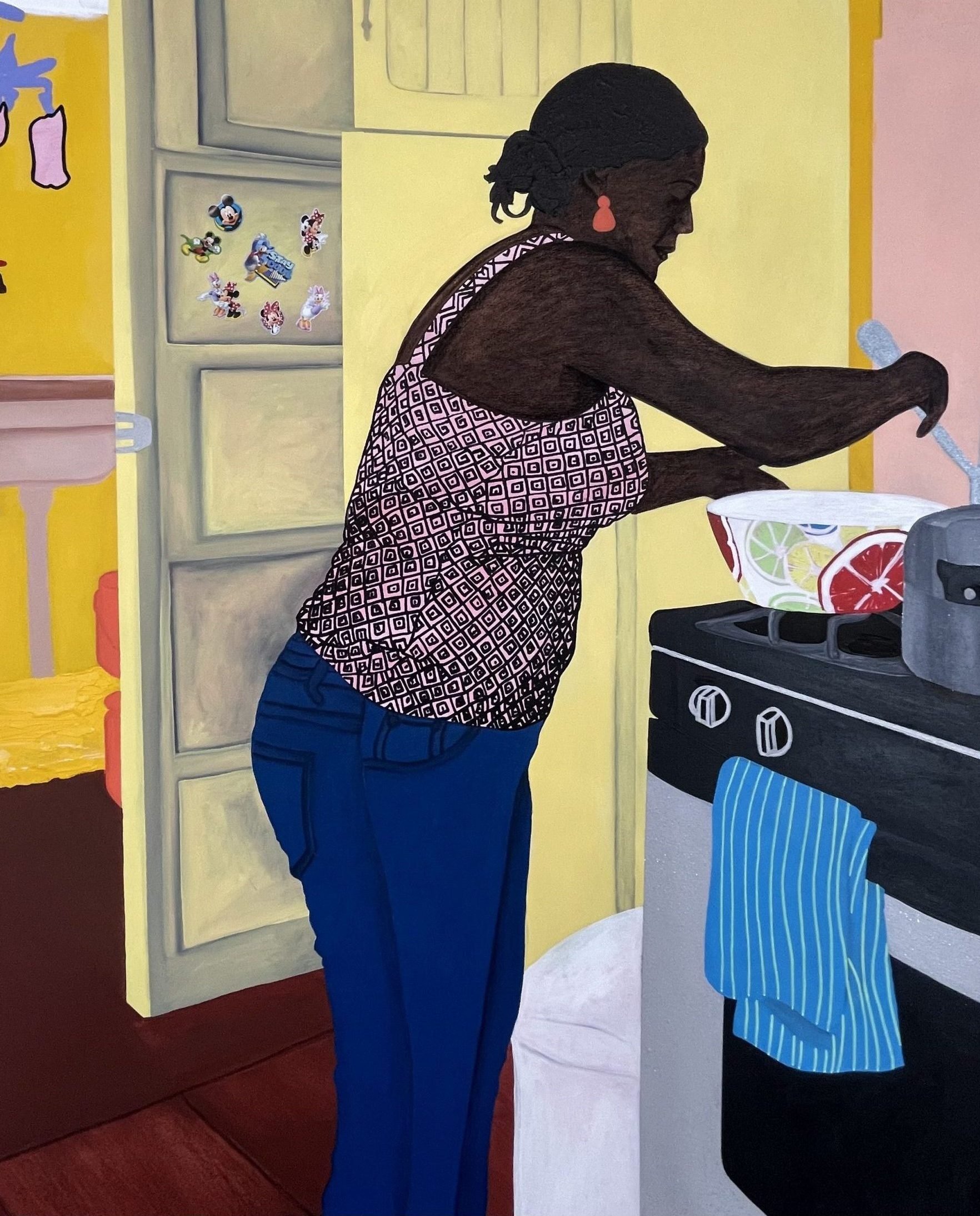
Romi 2021
Acrylic paint, charcoal, stickers, and glitter on stretched canvas, 48x60 inches
“In the Dominican Republic it’s normal to have a trabajadora in your home, and Romi happens to be my aunt’s trabajadora for years now. Every summer that I would go back to the Dominican Republic, she would always be there to welcome me with open arms.” - Tiffany Alfonseca

Esta vez sera diferente 2020
Acrylic paint, charcoal, and glitter on stretched canvas // 30×40 inches
”For me this piece is a representation of Black and brown queer love, depicting how being queer can be challenging in the Latinx community and culture. ‘Esta vez sera diferente’ stems from wanting to change the narrative of forbidden queer love and embracing it instead in the Latinx culture.” - Tiffany Alfonseca
Summer-Fall 2021 Featured Artist: María Berrío

Oda a la Esperanza (Ode to Hope) 2019
collage with Japanese paper and watercolor paint on canvas, 92 x 118 inches
María Berrío
I recently discovered the vibrant work of María Berrío through this Hyperallergic review entitled: “‘These Are the Women I Want to Be’: María Berrío’s Visions of Displacement.” Inspired by Latin American Realism, narratives of displacement, and the nonhuman environment, Berrío creates giant collages using watercolor and decorative paper sourced from Japan and elsewhere.
María Berrío (b. 1982) was born and raised in Bogotá, Colombia, and spent much of her childhood living on her family’s mountainside farm where she developed a unique and lasting connection to nature. At eighteen Berrío relocated to New York and received her BFA at Parsons School of Design in 2004, followed by her MFA at the School of Visual Arts in 2007.

Berrío describes the women in her work thus: “They are embodied ideals of femininity. The ghostly pallor of their skin suggests an otherworldliness; they appear to be more spirit that flesh. These are the women I want to be: strong, vulnerable, compassionate, courageous, and in harmony with themselves and nature. They combine the elements of women who are typically thought of as powerful – the captains of industry, resolute politicians, fiery activists – with the traits of those who are not usually thought of as such, thereby underlining the common force found in all women. The female soldier fighting on the front lines is of interest, but so too is the mother who finds a way to feed her children and sing them to sleep amid bombing campaigns and in the ruins of cities. To truly ennoble womanhood, we must discover and appreciate the beauty in every action, big or small.”
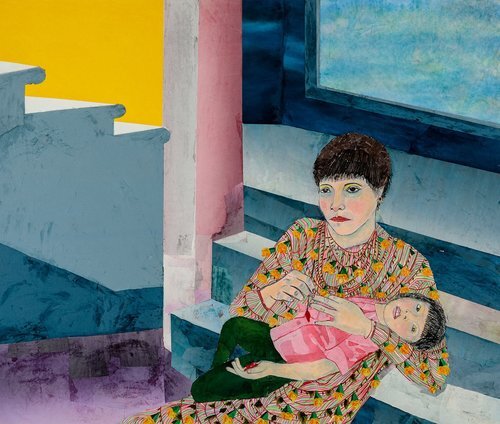
Genipa 2019
collage with Japanese paper and watercolor paint on canvas, 60 x 72 inches

Cricket Song 2017
Japanese paper on canvas

The Dream of Flight 2019
collage with Japanese paper and watercolor paint on canvas, 60 x 72 inches
Spring 2021 Featured Artist: Asami Kiyokawa

Greed
from the Complex Series: 2007 photo, thread, beads
Asami Kiyokawa
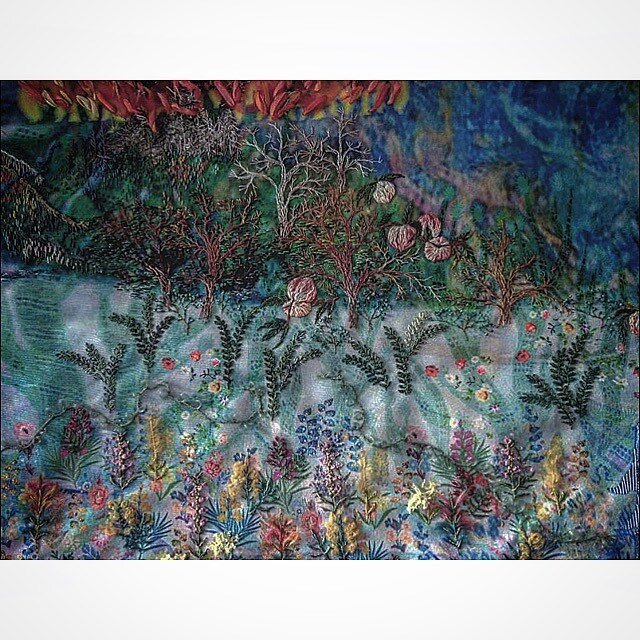
Asami Kiyokawa was born in Awaji Island, Japan in 1980. She held her first solo exhibition in 2001 and in 2011 became the youngest artist to hold a solo exhibition at Mito Art Tower. Asami is an embroidery artist who uses a needle and thread—along with other materials—to overlay an imaginative new world onto her photographs.
The image above comes from Kiyokawa’s “Complex Series,” of which her website notes: “Probably everyone has a complex of some sort. Something that attracts our concern, causes us to worry, and triggers our efforts to overcome it. Kiyokawa felt that way when she was working as a model. Eventually, she came to realize that her complex could become her originality, or her own distinctive quality. For this series, the artist took a number of photographs of the same model, and used them as the base for work on the theme of typical complexes that trouble women.”
I wasn’t able to obtain copies of the pieces I most admire, so I highly recommend exploring Kiyokawa’s website. I am especially fond of the “Mythology” series.
The images that follow are pulled from Kiyokawa’s social media account.


Fall 2020 Featured Artist: Felicia Van Bork
I believe I must be painting this way because I am in revolt against the unconsidered opinions expressed by people in the news these days. There is an aching need for empathy and tenderness in the world and I am teaching myself these things as fast as I can. —Felicia van Bork, March 28, 2020

Comment 17
2019, oil on canvas, 14 x 11 in.
Felicia Van Bork
Born in Toronto, Canada, Felicia van Bork completed her undergraduate studies at the Ontario College of Art and Design University and earned her MFA at the Massachusetts College of Art and Design at the Fine Arts Work Center, Provincetown, MA.
The artist's paintings and collages are widely collected in the United States and Canada and Felicia has been the recipient of numerous residency fellowships, including from the Virginia Center for the Creative Arts and McColl Center for Art + Innovation, where she manages the printmaking studio. In the summer of 2017, she was a Visiting Artist at the American Academy in Rome.
But what I really love is her series of How To collages…

How to Turn the Moon
2014, collage on panel, 36 x 36 in.

How to Beckon
2015, collage on panel, 36 x 36 in.
Watch Felicia van Bork discuss her collage process!

How to Divide and Multiply
2015, collage on panel, 36 x 36 in.
Recommended Reading: Lauren Russell's Descent
Lauren Russell’s Descent came out from Tarpaulin Sky Press last month—a gorgeous hybrid book that I count among the best recent poetry collections.
From Tarpaulin Sky:
In 2013, poet Lauren Russell acquired a copy of the diary of her great-great-grandfather, Robert Wallace Hubert, a Captain in the Confederate Army. After his return from the Civil War, he fathered twenty children by three of his former slaves. One of those children was the poet’s great-grandmother. Through several years of research, Russell would seek the words to fill the diary’s omissions and to imagine the voice of her great-great-grandmother, Peggy Hubert, a black woman silenced by history. The result is a hybrid work of verse, prose, images and documents that traverses centuries as the past bleeds into the present.

Read this great Poets & Writers interview with Lauren (in which I get a little shout out).
An Introduction to Seasteading
I’m pleased to announce the publication of my first “long” poem (the long ones are always so hard to place!). If you want to know more about the Seasteading movement, visit Pleiades Volume 40 . This six-page poem appears alongside a really cool poetic celebration of the periodic table. You can also read “Seasteading” here.

Spring 2020 Featured Artist: Angela Dufresne

The Lonely are the Brave
2018, 48 x 62 inches, oil on canvas
Angela Dufresne
Angela Dufresne is a painter, teacher and occasional writer who has shown her work in the U.S. and Europe since 1993. She has been the subject of twenty-three solo exhibitions and participated in over 100 group shows. Dufresne’s “work articulates non-paranoid, porous ways of being in a world fraught by fear, power and possession. Through painting, drawing and performative works, she wields heterotopic narratives that are both non hierarchical and perverse” (angeladufresne.org).
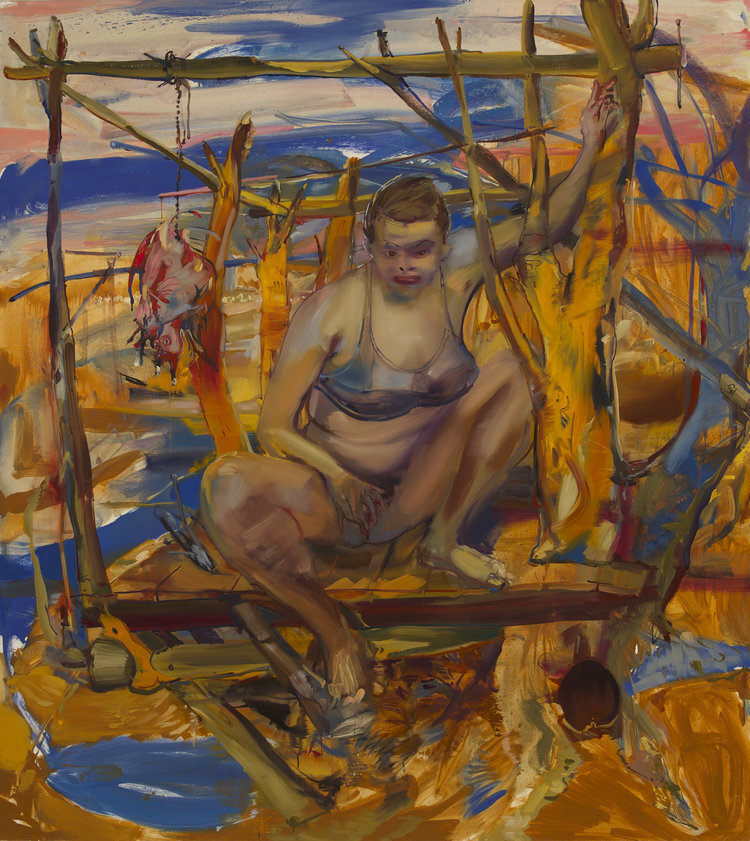
Maritza Ranero or Kiss the Cunt of God
2018, 72 x 66 Inches, oil on canvas
Dufresne’s paintings exuberantly weave imagery, narrative, paint, and visceral pleasure. She refers to the work as examples of non-paranoid, porous ways of being in the world. Delivered with absurdity, affection and feminist vibrato, Dufresne presents figurative articulations that feverously emerge out of the paint. Humorous, giddy, vulnerable, non-heroic, perverse, her figures revel in their destabilized relationship to their environments. Her subjects are nether man nor nature, form or formless, but allow for both to coexist in their lack of selfhood and their openness to absorb, fuse with, metabolize the world around them. In cinematic dissolves they conjure up the centrality, the ontology of humanity, as challenged. Deft in techniques of revision, erasure, overlay and addition, Dufresne deploys empathy and humor with equal parts skill and sensitivity in a commitment to painting’s ability to present, transgress and reconfigure experience and representation. (Guggenheim Foundation)

Perfect In Every way Except No Nose
2013, oil on canvas, 24 x 28 inches
See Hyperallergic for more on Dufresne:
”Beer with a Painter: Angela Dufresne”
”Angela Dufresne Queers the Portraiture Tradition”
"No One Should Feel That Alone" up at Green Mountains Review
I’m excited and grateful to have another poem from my second manuscript up at Green Mountains Review. And it comes with this beautiful apropos photo:

Summer 2019 Featured Artist: Julie Curtiss
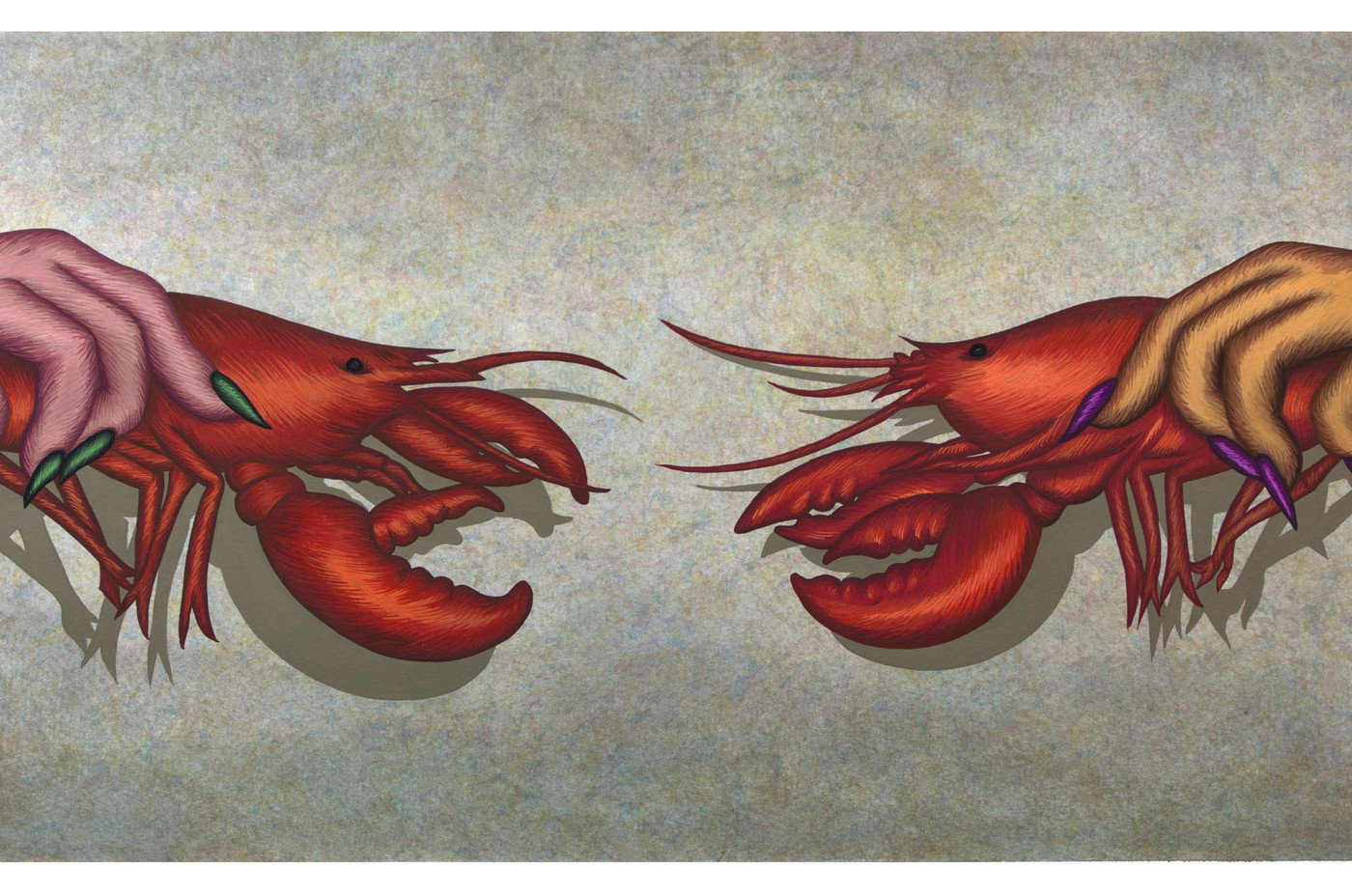
Duel
2018, Gouache on paper, 12 x 26 inches
Julie Curtiss
Julie Curtiss is a French artist based in Brooklyn. In 2004, she studied at the Art Institute of Chicago thanks to a Louis Vuitton Moet Hennessy Award. After her graduation from l’Ecole des Beaux-arts of Paris in 2006, she lived in Tokyo. Influenced by the local art scene and Japanese graphic imagery, she started a new body of works focusing on drawing. After a brief come back in France, she finally settled in Brooklyn in 2010 and was recipient of a Van Lier Fellowship from the New York Foundation for the Arts in 2012. Curtiss shows her works in various venues and galleries of the New York City area.

ARTIST’S STATEMENT (From Maake)
“I enjoy associating humor with darkness, the uncanny and the mundane, grotesque shapes to vivid colors. I work from mental notes or imagination. With ideas of narration, I will utilize recurring elements from one painting to another, or leave some of the action outside the frame, thus creating a form of suspense.
My artworks are psychological. By omitting parts of an image or suggesting abnormal situations, I would like to contrast a feeling of familiarity with surrealism.
I am interested in the various aspects that female identity can take, especially through the opposite notions of Nature and Culture. I like to represent smoking teacups and cigarettes, objects that call to mind a domestic, tamed image of women. On the other side, organic, ambiguous body parts allude to the archetype of a woman fused with nature and her animalistic drive.
With faceless portraits of women, gnarled fingers and toes, and voluptuous bodies composed of hair, I would like to present the viewer with an enigmatic puzzle, an invitation to reflect on the idea of an unfixed, ever-changing self.”

The Test, 2016
Gouache on paper
12 x 16 inches

Appetizer, 2017
Gouache on paper
12 X 9 inches

Tea for two, 2016
Acrylagouache on paper glued on panel, 20 x 24 inches

Chinatown, 2018
Acrylic, vinyl, and oil on canvas, 30 x 40 inches
Spring 2019 Featured Artist: Luchita Hurtado

Encounter
oil on canvas, 50 x 95 3/4 inches 1971
Luchita Hurtado
From the Hammer Museum:
“Over the course of her long career, Luchita Hurtado has maintained a rigorous commitment to experimentation—with styles, forms, and materials, and across a range of media. Hurtado’s works from the 1940s and 1950s primarily consist of paintings and works on paper that contain abstract forms, biomorphic landscapes, totemic figures, and patterns. These early works also convey Hurtado’s ideas about humanity, the universe and the cosmos, and nature and the environment, themes that continue to inform her oeuvre.
The works that span the late 1960s to the 1970s, a time when the artist primarily divided her time between Taos and Los Angeles. During this period, her work shifted from biomorphic abstraction to more figurative representations. This departure was inspired, in part, by the political and social changes occurring in the United States and throughout the world, including the women’s liberation movement and the beginnings of the environmental movement. Hurtado was particularly attuned to the activities of the women’s movement, and representations of her own body are, as she has put it, an “affirmation of self,” an assertion of her own presence and power. Many of these paintings are rendered from above, with Hurtado’s breasts, arms, legs, feet and hands partially visible against backdrops of patterned floors, planters, and woven baskets.”
Luchita Hurtado (b. 1920 Caracas, Venezuela) works in Santa Monica, California. In 1928 Hurtado immigrated to New York City, where she studied at Washington Irving High School and the Art Students League. She began her career in the early 1940s as a fashion illustrator for Condé Nast and as a muralist for Lord & Taylor. In the mid-1940s, Hurtado frequently traveled between New York and Mexico City, where she worked within an international group of artists and writers who were part of the World War II diaspora. In the late 1940s, Hurtado moved to Mill Valley, California, where she associated with the Dynaton Group. In 1951 she moved to Los Angeles, where she has resided ever since. Recent solo exhibitions include the Annenberg Community Beach House, Santa Monica (2017) and Park View Gallery, Los Angeles (2016). Prior to these, her last solo exhibition was held at the Women’s Building, Los Angeles (1974). Hurtado has exhibited sporadically from the 1950s until the present, including at Night Club Gallery, Chicago (2016); Carnegie Art Museum, Oxnard, California (1994); Tally Richards Gallery, Taos, New Mexico (1970); and Paul Kantor Gallery, Los Angeles (1953).

Untitled
oil on canvas 1970
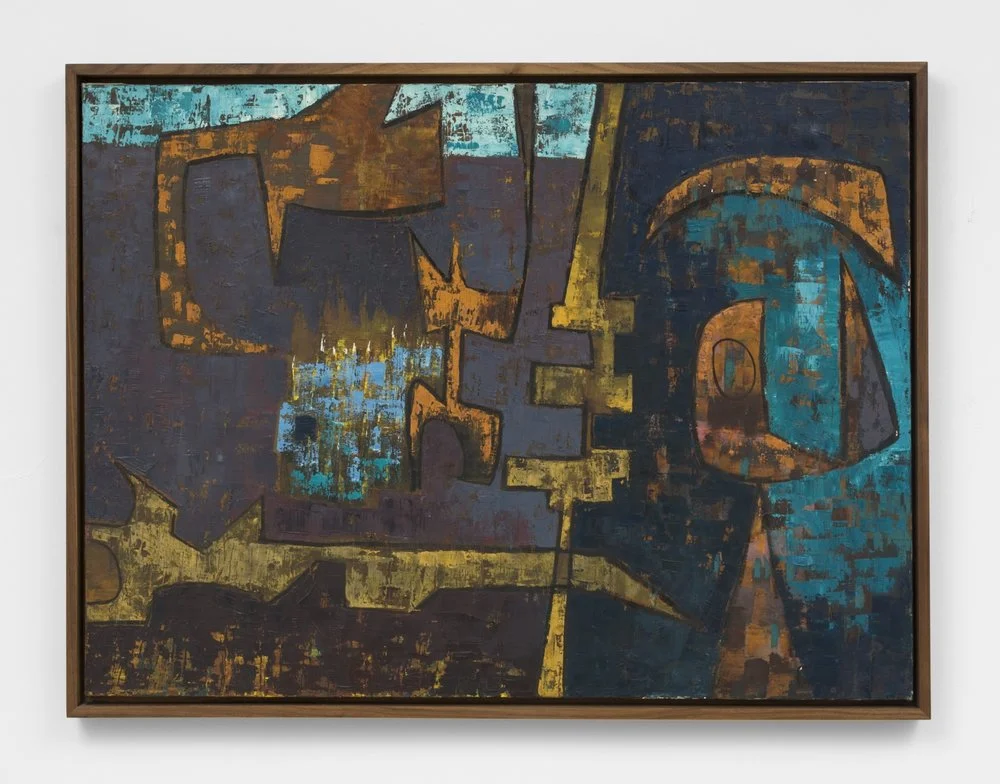
Untitled
oil on canvas, 28 x 36 inches 1952
New Poems in Issue 18 of Sugar House Review!
I’m honored that two poems from my new manuscript, “October Renga” and “Boston Under Water by 2100,” are in Issue 18 of Sugar House Review.
Here’s a sneak peak of the new issue—featuring poems by Rebecca Aronson, Steven Cramer, Thomas Moore, and others.
And much thanks to the editors for nominating “Boston Under Water by 2100” for a 2019 Pushcart Prize.
Currently Reading: Rose Alcalá's MyOTHER TONGUE
I am especially digging the prose poems in Rose Alcalá‘s MyOTHER TONGUE (Futurepoem, 2017). They are haunting and illuminating, and leave my mind hanging in multiple imagined places. Which is always something to admire in a poem: its ability to shift me elsewhere.
AT HOBBY LOBBY
She tosses a bolt of fabric into the air. Hill country, prairie, a horse trots there. I say three yards,
and her eyes say more: What you need is guidance, a hand that can zip scissor through cloth.
You need a picture of what you’ve lost. To double the width against the window for the gathering.
Consider where you sit in the morning (transparency’s appealing, except it blinds us before day’s
begun). How I long to captain that table, to repeat in a beautiful accent a customer’s request. My
mother cut threads from buttons with her teeth, inquiring with a finger in the band if it dug into
the waist. Or kneeled against her client and pulled a hem down to a calf to cool a husband’s collar.
I can see this in my sleep, among notions. My bed was inches from the sewing machine, a dress on
the chair weeping its luminescent frays. Sleep was the sound of insinuation, a zigzag to keep holes
receptive. Or awakened by a backstitch balling under the foot. A needle cracking? Blood on a white
suit? When my baby’s asleep I write to no one and cannot expect a response. The fit’s poor, always.
No one wears it out the door. But fashions continue to fly out of magazines like girls out of windows.
Sure, they are my sisters. Their machines, my own. The office from which I wave to them in their
descent has uneven curtains, made with my own pink and fragile hands.
Summer-Fall 2018 Featured Artist: Lee Price

Self-Portrait in Tub With Chinese Food oil on linen, 44" x 44" 2009
Lee Price
American painter Lee Price focuses on the subject of food with the solitary female figure in private, intimate settings — figures that are always lost in what might appear to be the bliss of consumption in highly unusual environments and portrayed from a unique aerial point of view. This odd perspective creates an illusion or feeling of an out of body experience as if the subject is looking down at herself. While clearly demonstrating her amazing technical skills, the circumstance of consistently depicting female figures in the act of compulsive behavior tends to hint at an underlying message. Price’s paintings have been the subject of numerous solo and group shows across the United States. She is represented by Evoke Contemporary in Sante Fe, New Mexico, and Wendt Gallery which has showrooms in Laguna Beach, New York, Singapore, and Vienna. Lee currently lives and works in Beacon, New York.
Artist's Statement:
"There are two threads that my paintings follow: one being a discussion on women’s relationship with food, the other being a discussion on compulsive behavior. At times the two threads intertwine. The overhead perspective emphasizes the fact that the women are watching their own actions; watching themselves in the middle of their out of control behavior but unable to stop. The settings are private spaces, spaces of solitude, and mainly, unusual places to find someone eating. The private space emphasizes the secrecy of compulsive behavior and the unusual settings emphasize its absurdity. The solitude/peace of the setting is a good juxtaposition to the frenetic, out-of-control feel of the woman’s actions.
One of the most potent messages these pieces deliver is that of excessive waste. Not just material waste but the waste of time and energy that is used up in obsession. Energy that could be directed towards productive endeavors, through our compulsive activity, is instead being used to wrap us in a cocoon. Where we could be walking forward, we instead paralyze ourselves. For the women in these paintings, even with an excess of food, there is no nourishment. Unable to sit with the discomfort/unease of the present moment, these women take in excessive amounts and in the process are shutting out the possibility of being truly nourished.
Most women are brought up to be givers. To nurture others at the expense of our own needs. We hide our appetites, not just for food but in many areas of our lives, and then consume in secret. In my most recent works the women seem to be coming out of the closet. Eyeing the viewer — not censoring their hunger. My paintings ask what is it that truly nourishes us and how truthful can we be about the size of our hunger?"

Asleep oil on linen, 56" x 38" 2009

Cocoa Puffs oil on linen, 44" x 62" 2009
Currently Reading: Lauren Russell
I've recently been enjoying the fabulous Lauren Russell's What's Hanging on the Hush. My favorite thing about Lauren's poetry is her keen attention to musicality, a word sound skill at which not every poet is so deft. Consider the following example:
Throat to Ink, Ink to Fin
When I was ten,
my class went whale
watching off the California Coast.
I remember that time as worried
and tall, salt wind halo of frizz
gangly tip toe tripping
toward the rail, alone,
under my breath singing
"Shenandoah." I imagined
a soundtrack to my life, railed
in vibrato strain of bent-back
wind. The hiccup hack, leaning in.
My student writes an essay
about " the loneliest whale" that sings
at a pitch no other whale can hear. (Pitched
into the waves, an ocean tent, bent.)
"But how do you know it's the loneliest?" I insist.
When I was nine, calluses
on my palms from monkey bars,
I sang No man can a hinder me,
barring no note swung
vibrato lunge. But the end
of last summer hung
on a mockingbird song:
And the mockingbird
can sing like the crying
of a dove, the note bent
around a long vowel
strain, and notes
stuck to a mirror, and ink
tripped in the glass, fluke
and flippers rising back.
And my favorite poem in the collection:
On Loneliness
I am lonely because I could not learn to be a body.
I was born upside down and could never balance on one foot.
I am lonely because there were too many cherry popsicles.
I was holding out for mango, and thus I missed the lesson on sucking up.
I was there for the lesson on ventriloquism: Be careful
when you transfer your voice to another. She might sell it on eBay.
He might dump it in the compost bin. You might be like the Little Mermaid,
lost outside your element, unable to speak to the Handsome Prince.
That is how I feel at parties, but I never had a singing lobster to help me adjust.
I am lonely because I shy away from lobsters.
I saw them crammed together in the supermarket tank, desperate with their pincers bound.
I was fourteen when I became a vegetarian. I was nine when I stopped watching TV.
I am lonely because I do not have a television.
When everyone talks about the latest reality show star, I say, "Who's that?"
and feel bored and superior. I was fifteen when I read Lolita in the bath--
an advantage of contact lenses, to be able to read in a room full of steam.
I am lonely because I stopped wearing contacts.
Some mornings someone steps onto the fire escape and empties a bucket
or bowl or bedpan or bamboo pot. I am always half asleep, and myopic
without my glasses I cannot tell if the dumper is a man, woman, child, or angel.
I am lonely because I never go to the window to find out.

Spring 2018 Featured Artist: Toyin Ojih Odutola

Mineral Survey marker and pencil on paper 2015
Toyin Ojih Odutola
Toyin Ojih Odutola (b. 1985, Ife, Nigeria) creates drawings utilizing diverse mediums to emphasize the striated terrain of an image and its formulaic representations. She earned her BA from the University of Alabama in Huntsville and her MFA from California College of the Arts in San Francisco. Ojih Odutola lives and works in New York.
Through black ballpoint pen ink, Toyin Odutola’s drawings question physical and sociopolitical identities as they pertain to skin color. Treating skin as topography, she layers ink as a means of mapping a person’s subjective, individual geography built from real-life experiences. Her interest in surface qualities stems from the history of African textiles, which inspires the artist’s rich textures on flat planes. Concerned with historical representations of black subjects in portraiture, Odutola undermines notions of blackness in her drawings by exploring what it means to look or be perceived as black, as, while drawn in black ink, not all of her subjects are of African descent. More recently, Odutola has begun to look beyond pen ink, working with charcoal and pastels to reflect the cultural diversity and ambition of American cities.
From the SCAD Museum notes on her exhibition, Testing the Name: The artist's unusual approach to the rendering of skin and its textures is an acute and considered comment on the representation of blackness. Her velvet, seductive surfaces claim territory within the art historical canon of portraiture, which historically favored whiteness. Ojih Odutola's radical black skins seemingly bend light, resisting a logical visual comprehension that speaks as complex metaphor.
The artist’s subjects are itinerant, cosmopolitan and, while intentionally not recognizable, drawn partially from her own inner circle. Ojih Odutola places individuals and couples in opulent interiors and rich landscapes, at leisure and in social interactions. Architectural details and objects surrounding her subjects receive equal attention. Of Nigerian descent, she grew up in the American South and developed a seemingly plausible narrative incorporating themes that, in reality, might not be so straightforward. The artist’s choices are a statement and decision to self-determination and, through their representation, bring into reality a hopeful present.

Toyin Ojih Odutola in New York, December 2015 Photo: Vicente Muñoz

Pregnant charcoal, pastel and pencil on paper, 74 1/2 x 42 in. 2017
AWP 2018
Good times at AWP 2018 in Tampa. Presented on a couple of panels. Visited with many old friends. And we introduced Berkeley to AWP! He did not like the bookfair.

The three-owl family with our friend, the awesome poet, Lauren Russell.
Winter 2018 Featured Artist: Amy Sherald

The Fairest of the Not So Fair oil on canvas, 72 x 67 inches 2008
Amy Sherald
Amy Sherald (American b. Columbus, GA 1973, lives Baltimore) received her MFA in Painting from Maryland Institute College of Art (2004), BA in Painting from Clark-Atlanta University (1997), and was a Spelman College International Artist-in-Residence in Portobelo, Panama (1997). In 2016, Sherald was the first woman to win the Outwin Boochever Portrait competition grand prize; an accompanying exhibition, The Outwin 2016, has been on tour since 2016 and will open at the Kemper Museum, Kansas City, MO in October 2017. Public collections include Smithsonian National Museum of Women in the Arts, Washington, D.C.; Smithsonian National Museum of African American Art and Culture, Washington, D.C.; Smithsonian National Portrait Gallery, Washington, D.C.; Columbus Museum, GA; Kemper Museum of Contemporary Art, Kansas City; and Nasher Museum of Art, Durham, NC. Sherald is represented by Monique Meloche Gallery, Chicago.
From the recent New York Times article, "Why the Obamas' Portrait Choices Matter":
"Ms. Sherald’s subjects...are mostly young and come in all shapes and sizes. Her images play black and white against color in different ways, most obviously in the skin tones, which are painted on the gray scale. This recalls old photographs but mainly gives the figures a slight remove from the rest of the painting, one that also signals their awareness of the obstacles to their full participation in American life. This simple device introduces the notion of double consciousness, the phrase coined by W.E.B. DuBois to describe the condition of anyone living with social and economic inequality."
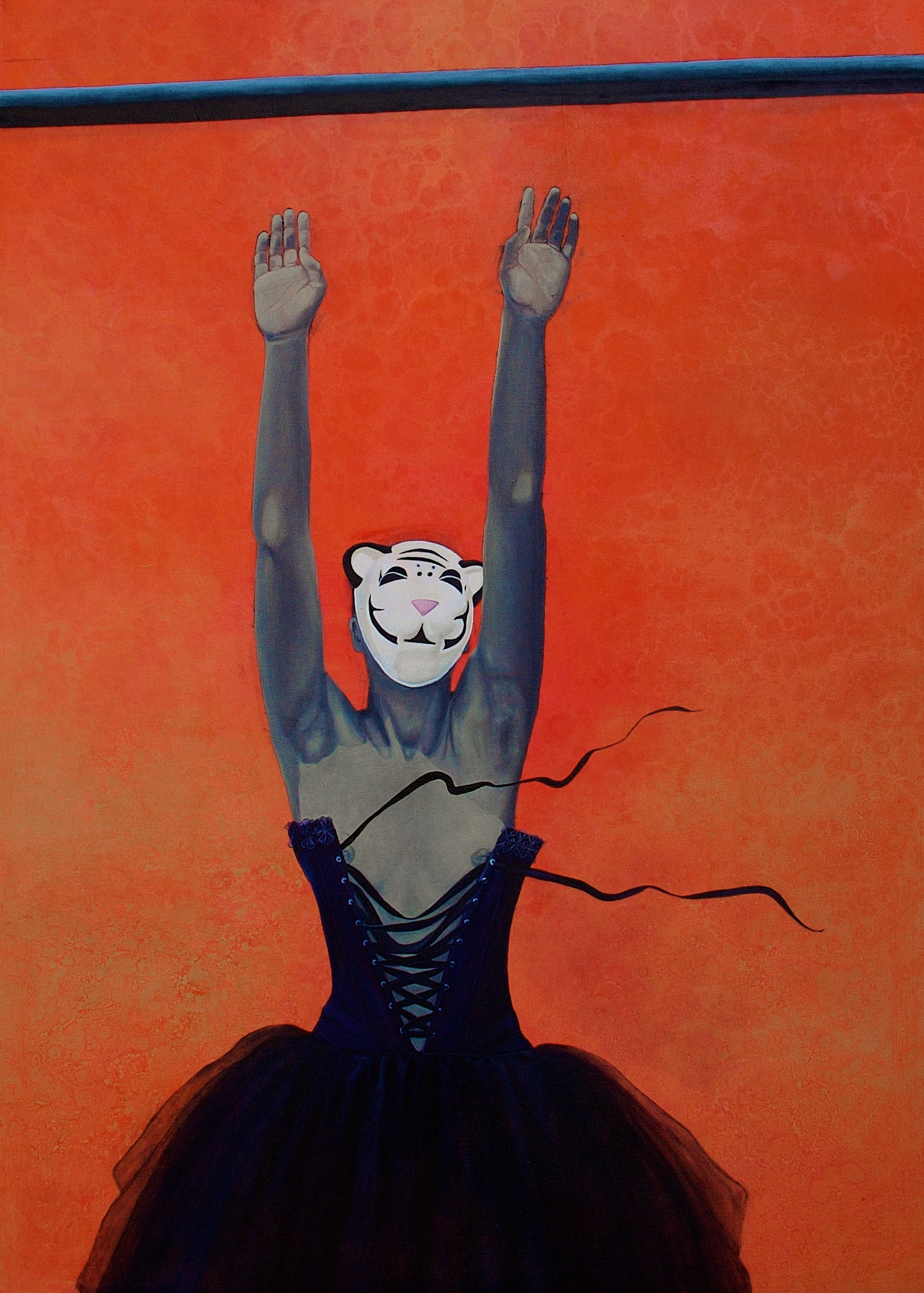
Maybe If I Wore a Mask oil on canvas, 71 x 51 inches 2009

Equilibrium oil on canvas, 100 x 67 inches 2012
